


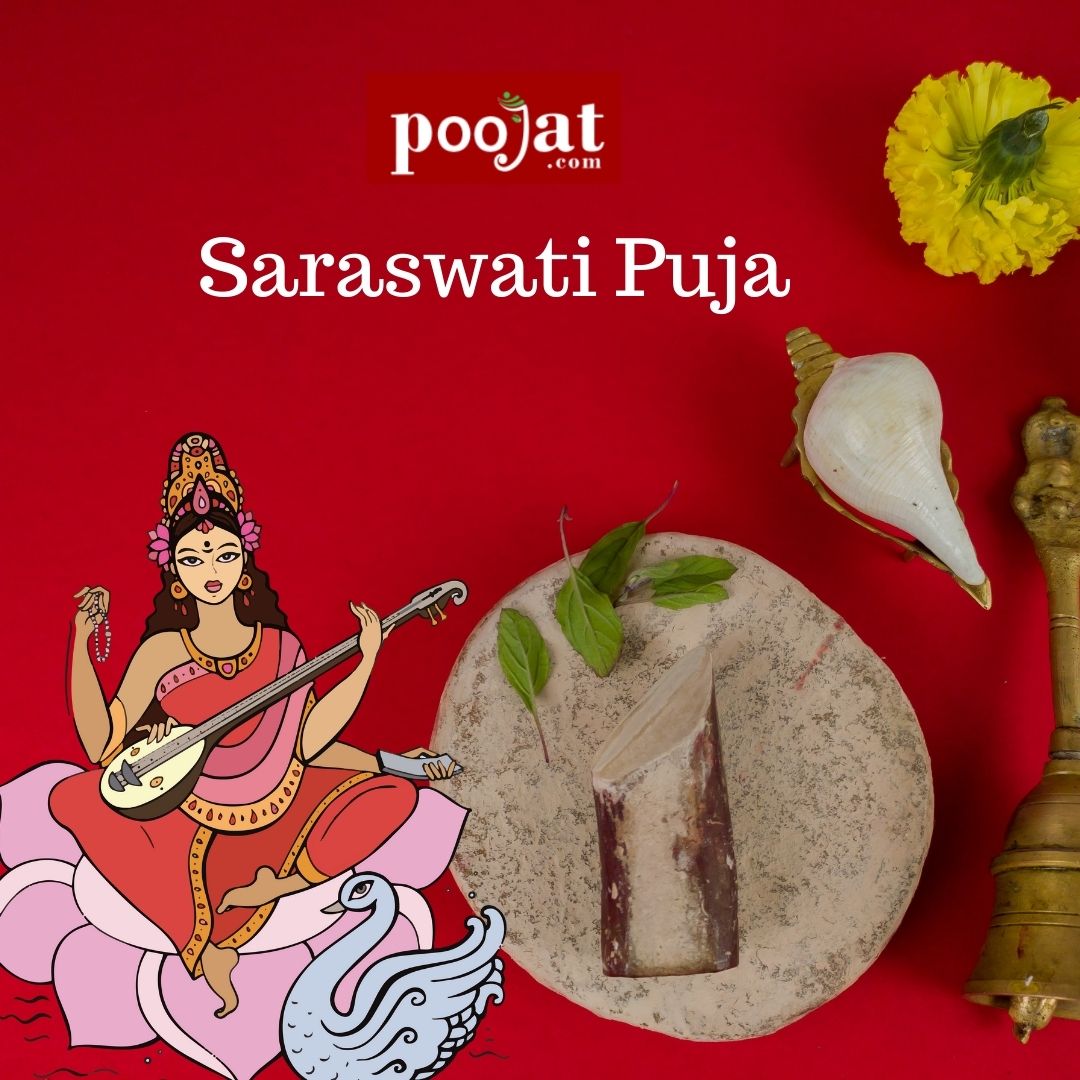
Saraswati pooja
An important Hindu festival called Saraswati Puja honours Goddess Saraswati, the embodiment of wisdom, knowledge, and the arts. Students, professionals, artists, musicians, and scholars all celebrate this important occasion with great fervour, seeking the blessings of Goddess Saraswati to further their artistic and scholarly endeavours. Saraswati Puja is especially well-known during the nine-night Navratri festival, which honours several Goddess forms.
The goddess Saraswati is worshiped as the divine representation of communication, art, and knowledge. She is frequently shown playing the Veena, a traditional musical instrument, while perched on a white lotus. She rides a swan and represents purity and wisdom while wearing a white saree. "Saraswati" is a name with several meanings. It can be formed from the words "Vati," which means a woman, and "Saras," which denotes a body of water. As "Saras" also means speech in another sense, Saraswati is the goddess of speech. Dividing the word into its constituent parts, "Sara," "Sw," and "Vati," reveals the core of self.
Through the Saraswati Puja ritual, devotees can call upon the blessings of the goddess Saraswati. Depending on the area, several dates are used to celebrate it. The ninth day of Navaratri, or Navami, is when Saraswati Puja is performed in South India; in North India, it falls on Basant Panchami. On the ninth day of Navratri, Saraswati Devi changes into Mahasaraswati. It is said that she made strong weapons to defeat the monster Mahishasura, which later came to be revered. This custom gave rise to the "Ayudha Puja," a ritual in which everyday objects and tools are worshipped.
Devotees worship several forms of the Goddess during Navratri, giving particular objects to correspond with each form. Saraswati Devi is worshipped on the last day, when people ask for her blessings in order to gain wisdom and knowledge. Goddess Saraswati is honoured during Basant Panchami, a festival celebrated in North India, which highlights the goddess' importance in the field of knowledge.
Saraswati Puja is frequently performed in temples and households. White flowers, especially white jasmine, are traditionally offered in garlands by devotees since they are thought to be extremely auspicious and represent purity. In order to obtain the goddess' blessings for academic success, children and students offer her their school books, laptops, stationery, musical instruments, and other learning tools. On this day, it is traditional for pupils to neither study or read. White jasmine garlands are another common prasadam (holy offering) offered by many.
Special foods like Sundal, a simple sweet, and Suyyam/Suzhiyan, a simple sweet, are prepared and offered to the Goddess in South India. Recitations of hymns or slokas devoted to Goddess Saraswati accompany the puja, which is performed with tremendous devotion.
The celebration of Saraswati Puja holds great cultural and historical importance. On the ninth day of Navaratri, people celebrate the victory of good over evil, which is symbolised by the destruction of the demon Mahishasura by Goddess Durga's incarnation, Chamundeshwari. Arjuna, one of the Pandava brothers, is also linked to this day. On Vijaya Dashami, he discovered his weapon concealed in a Shami tree, signifying his triumph in the Kurukshetra conflict. For this reason, it is a lucky day for young children to start formal education.
Also Read: Want to know in depth about Satyanarayan Puja ?
The importance of Saraswati Puja rests in its capacity to improve scholastic performance, knowledge, wisdom, artistic and technical talents, and other human endeavours. It is said to confer discernment, mental acuity, and the capacity to anticipate dangers connected to particular goals. Many people consider this day to be very fortunate and decide to launch new businesses on it.
The first step in the Saraswati Puja traditions is for devotees to rise early and bathe in sacred leaves like neem and tulsi. Some people use a paste made of turmeric and neem to apply to their bodies for therapeutic purposes. White clothing is regarded as auspicious. Houses get a thorough cleaning, and flowers and other decorations are placed in the puja area.
A garland is placed around a statue or portrait of Goddess Saraswati, and a Kalash—a copper jar filled with pure water, aromatic herbs, and spices—is arranged. The Kalash, adorned with a fragrant blend of unique powders and oils, is topped with coconut and mango leaves.
Also Read :About Shuddhikaran Puja
Pradasadam is a special meal served by devotees, who also spend the entire day reciting prayers and devotional songs. Many decide to abstain from heated meals and fast. Everything about it radiates love and devotion, which greatly enhances one's spiritual condition.
Saraswati Puja celebrations are beneficial for improving one's capacity for discernment, learning, and clear thinking. On this day, people honour the goddess of wisdom and knowledge and ask for her blessings to succeed in a variety of undertakings.
There are many names for the goddess Saraswati, such as Veenapani (the goddess carrying the Veena), Hansvahini (the goddess sitting on the swan), Maa Sharde (the goddess of the autumn season), Vageshwari (the goddess of speech), and Pustak Dharini (the goddess carrying books). Her four arms are a sign for her associations with many facets of the human psyche, such as thought, intelligence, attentiveness, and ego. The swan, her chosen transport, is a revered bird with the ability to discriminate between good and evil. Occasionally, peacocks are also shown at her feet, signifying wealth and colourful splendour.
Also Read: Explore about different type of puja in Hindu Culture
Many nations, each with its own distinct customs and traditions, celebrate Saraswati Puja, including India, Nepal, Bali, Thailand, Myanmar, Pakistan, Bangladesh, Bhutan, Mauritius, Surinam, Fiji, Japan, and Tibet. This festival crosses national boundaries to disseminate art, wisdom, and knowledge around the globe.